

Reset Maybe?
On perfectionism, and notes that never become notes.
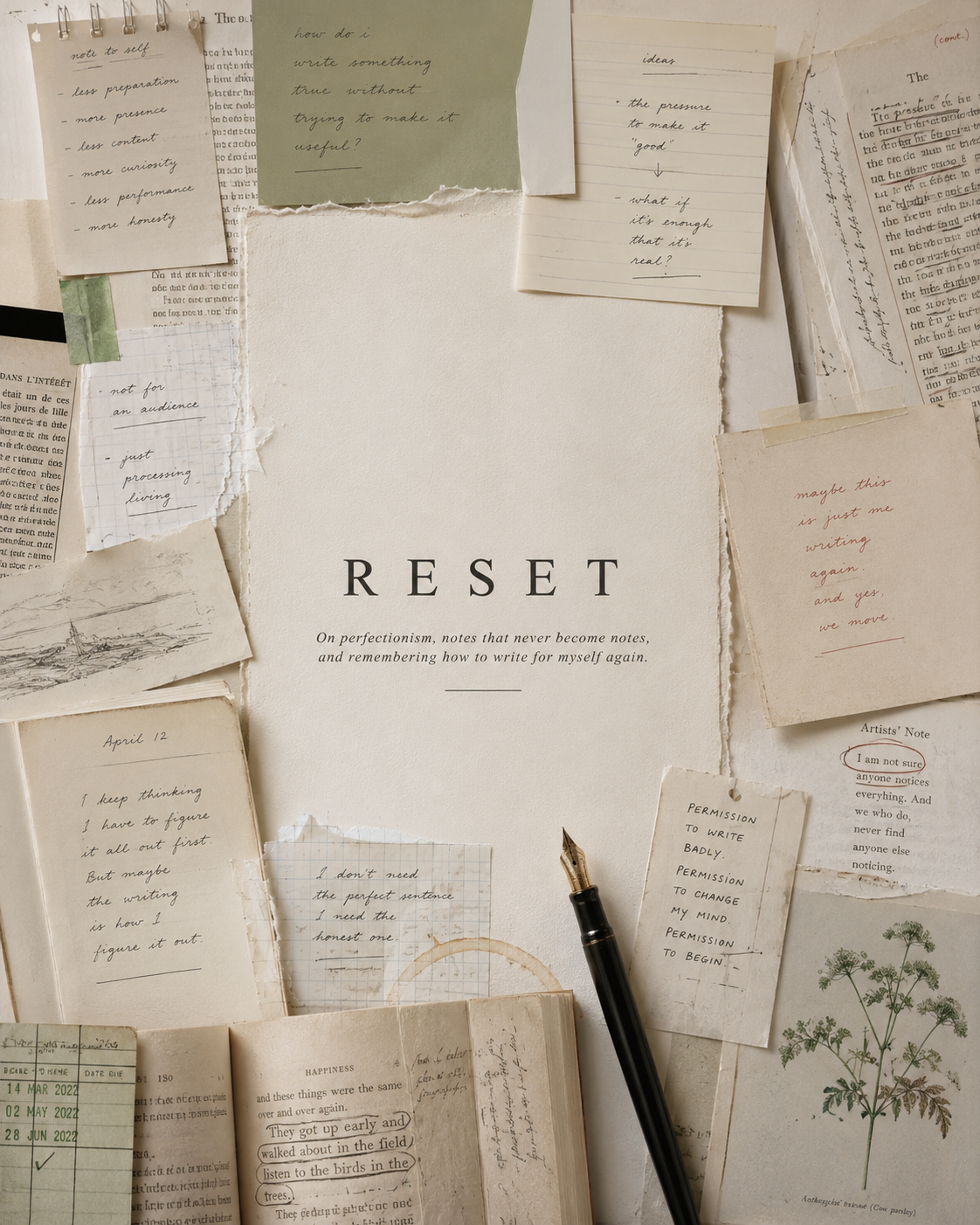
About 6 months ago, I made a solemn promise to myself: I was going to write every single day. I bought a beautiful new notebook (around 7 - there was a sale, and I thought, why not, I could have different books for different themes), I cleared my desktop, and waited for the magic to happen.
But I didn't write. Not really. Instead, I got entirely caught up in the pressure of "making content." Every time I sat down, I was trying to produce a finished product that could perform. I would spend hours looking over, checking tags, researching how to SEO optimise, creating several post captions to drive traffic, because surely I must be crazy to just create and not expect some kind of instant gratification or reward for it, right?
Meanwhile, my brain was overflowing. I would find myself scrolling mindlessly on my phone, feeling a sharp twist of frustration. I had so many thoughts about daily life, so many reactions to the books I read, the films I watched, and the conversations I overheard. But I had no way to trace them. My intellectual life was a mess of digital drift, fleeting insights scattered across Apple Notes, chaotic chatbot histories, a long wall of posts forwarded to my Finsta and forgotten, dusty Notion databases. I had the raw materials of a creative life, but they were dying in the margins of my digital clutter.
My somewhat of a breakthrough didn't come from a productivity hack or a new organisational app, although I have downloaded a bunch of new ones, used them for some time and then met with the subscription thing, which puts me off, so then they go to die somewhere on my phone until I magically run out of space. Not to get off the subject, I think what's probably been the most helpful thing is realising I wanted somewhere to write down all the notes on the things I’ve been learning. I have made a conscious effort to engage more with the humanities, read more, and spend time with the books on my shelves. To start writing again, I had to lower the stakes. I had to learn how to play.
The 18th-century German philosopher Friedrich Schiller championed a concept called the Spieltrieb, the "play drive." Schiller argued that we are only fully human when we are at play. In play, the rigid rules of utility, logic, and survival are suspended. When I sit down to write now, I have to lock the editor out of the room so the creator can play with the clay. It reminds me of that classic scene in the film Finding Forrester, where the reclusive mentor instructs his student to "write your first draft with your heart, and re-write with your head." I had to give myself the radical, messy permission to write badly, to write loosely, and to write solely for the joy of finding out where the sentence would lead me.
I had more to write, but I am far too distracted by the collages I’ve finally managed to learn how to do again. the beauty in all this is that i get to use the art supplies I purchased for the younger human I happen to be a custodian of, and we spend time daily sitting writing drawing, lots of stickers + glue sticks and in the end we have these sort of mini portfolios. Pretty cool if you ask me. In true signing out fashion, I’ll leave some wise words. If you, too, are drowning in fragmented apps and half-forgotten thoughts, you don't need a dramatic life overhaul. You just need a shift in perspective. Start small. Today, write one paragraph. Do not edit it. Do not show it to anyone. Let it be fragmented, strange, or unpolished.
Three actionable micro-practices to jumpstart your writing today:
The Three-Line Observation: Before bed, write down exactly three things you saw, heard, or smelled today that were slightly unusual. Do not explain them; just catalog them in one physical notebook.
The Marginalia Exercise: Open a physical book you love. Find a sentence that frustrates or delights you. Write a one-sentence "argument" or response directly in the margin.
The Physical Sandbox: For twenty minutes, write by hand using a pen and paper. The physical friction of ink on paper slows down your internal editor, giving your creative instincts room to run ahead of your critique.
As Always Reita.