
In the space of a few days in early November 2026, Elastic, Coveo, Ideagen, 42Gears and VNPT Cyber Immunity all announced ISO/IEC 42001 certification of their AI management systems. BSI had reached its 50th certificate only weeks earlier (UKG Inc., 21 October). The announcements share a common phrasing: independent audit, responsible AI, simplified vendor assessments, support for customers facing the EU AI Act.
Institutions, education providers, public services and accessibility-focused organisations watching this wave are entitled to ask a sharper question. What does the certificate actually evidence, and what does it leave unanswered?
ISO/IEC 42001:2023 is a management-system standard. It specifies requirements for establishing, implementing, maintaining and continually improving an Artificial Intelligence Management System (AIMS). Clauses 4–10 follow the familiar Harmonised Structure. The distinctive elements are the AI-specific risk assessment (6.1.2), risk treatment (6.1.3), AI system impact assessment (6.1.4 and 8.4), and the Statement of Applicability, which records which of the 38 Annex A controls are applied or excluded and why. Certification is of the management system within a defined scope. It is not a product certification, not a test of model accuracy or fairness, and not a legal determination that any particular AI system meets regulatory requirements.
This distinction matters in practice. Elastic’s certificate covers Agent Builder, AI Assistants, the Elastic Inference Service and hosted Jina models. Coveo’s covers its AI-Relevance Platform in both producer and developer roles. 42Gears covers SureMDM and its use of third-party LLMs. Ideagen’s covers Mazlan and related LLM, RAG and agentic capabilities. Each is a legitimate organisational commitment to AI governance. None of them certifies that a specific model output is unbiased, that a particular high-risk system meets the EU AI Act, or that human oversight is effective in every deployment context.
The Statement of Applicability is where the certificate becomes more useful as evidence of governance. It records which Annex A controls the organisation has determined to be applicable, which have been excluded, and the reasons for those decisions. Procurement teams, risk committees, and public-sector buyers should seek access to the SoA or to relevant extracts and equivalent evidence where disclosure is restricted. Certification provides independently audited assurance that a management system meets the standard's requirements. What the certificate alone cannot show is how individual control decisions were made, or whether those controls will operate effectively in a particular deployment context.
The AI system impact assessment is equally material. Unlike an information-security management system, the AIMS requires organisations to assess consequences for individuals, groups and society, to revisit the assessment when systems change significantly, and to feed results back into risk treatment. ISO/IEC 42005:2025 provides guidance. In education, accessibility and public-service settings this requirement is not abstract. An AI tool that supports reading, assessment, translation or decision support for disabled learners, or that is used in student progression or resource allocation, can affect dignity, opportunity and equity. A competent impact assessment will surface those effects; a shallow one will not. Certification confirms that a process exists. It does not confirm the quality of every assessment performed under it.
Human oversight controls (notably in Annex A) raise similar institutional questions. Effective oversight is not a single “human in the loop” checkbox. It depends on competence, authority, available information and the design of the interface. In educational institutions or public bodies, staff may already carry high workloads. An AIMS that documents oversight without ensuring that the people expected to exercise it have the time, training, and decision rights to do so will fail to serve the purpose of the control, even if it passes an audit.
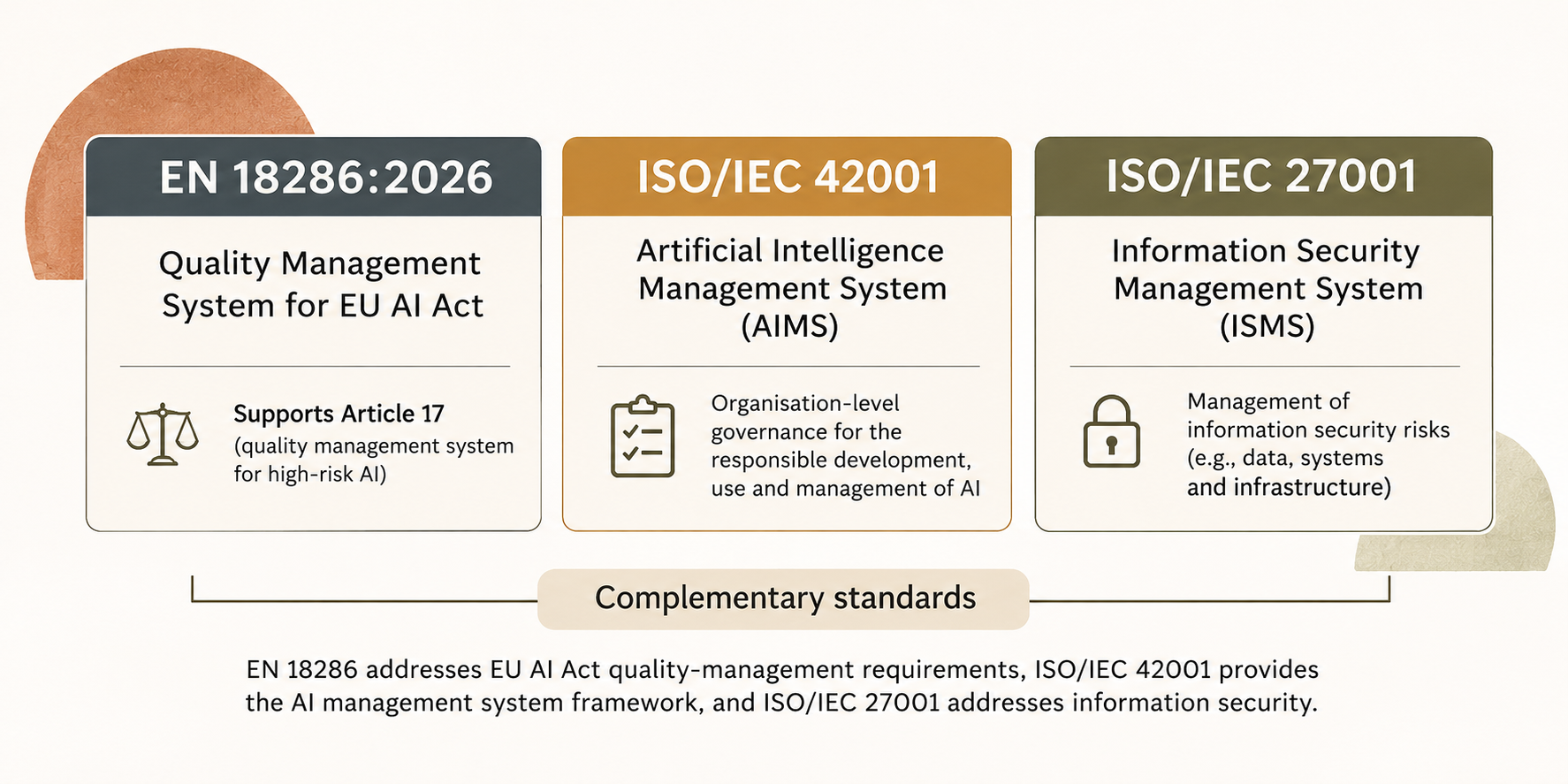
The relationship with the EU AI Act is now clearer and narrower than many vendor statements imply. ISO/IEC 42001 is not a harmonised standard. As of mid-November 2026, it confers no presumption of conformity under Article 40. The first harmonised standard for the quality management system required by Article 17 is EN 18286:2026, whose reference was published in the Official Journal by Commission Implementing Decision (EU) 2026/2274 on 14 October 2026. EN 18286 is designed to be layered onto existing systems (including ISO/IEC 42001 or ISO 9001) rather than to replace them. High-risk obligations under the Digital Omnibus timeline apply from 2 December 2027 (Annex III) and 2 August 2028 (embedded systems). An organisation that has built a solid AIMS is better placed to perform the gap analysis against EN 18286; the AIMS alone does not complete that work.
For public institutions, education providers and organisations concerned with accessibility, the practical implication is straightforward. The certificate is useful evidence of organisational governance. It reduces the cost of initial due diligence and demonstrates that someone has thought systematically about risk, impact and controls. It does not answer whether the particular AI system you are considering is appropriate for your learners, service users or residents, whether the residual risks are acceptable in your context, or whether the human oversight arrangements will function under real operational conditions. Those answers still require reading the SoA, examining impact assessments that touch your use case, and testing the practical operation of key controls.
The November wave shows that more organisations are moving from informal AI experimentation to auditable management systems. The institutional work that remains is to treat the certificate as the start of a conversation about evidence, not the end of one.
References
Elastic. “Elastic achieves ISO/IEC 42001 certification.” 9 November 2026. elastic.co/blog/elastic-achieves-iso-iec-42001-certification
Coveo. “Coveo Achieves ISO/IEC 42001 Certification.” 10 November 2026. prnewswire.com/news-releases/coveo-achieves-iso-iec-42001-certification-reinforcing-its-commitment-to-responsible-ai-838801475.html
Ideagen. “Ideagen achieves ISO/IEC 42001 certification.” 12 November 2026. ideagen.com/company/news/ideagen-achieves-iso-iec-42001-certification--the-international-standard-for-ai-governance
42Gears. “42Gears Achieves ISO/IEC 42001:2023 Certification for Artificial Intelligence Management Systems.” 13 November 2026. globenewswire.com/news-release/2026/11/13/3402739/0/en/42gears-achieves-iso-iec-42001-2023-certification-for-artificial-intelligence-management-systems.html
VNPT Cyber Immunity. “VNPT Cyber Immunity achieves ISO/IEC 42001:2023 certification for Artificial Intelligence Management System.” 13 November 2026. vnptit.vn/en/news/vnpt-cyber-immunity-achieves-iso-iec-42001-2023-certification-for-artificial-intelligence-management-system
BSI. “BSI awards its 50th ISO/IEC 42001 certificate.” 21 October 2026. bsigroup.com/en-GB/insights-and-media/media-centre/press-releases/2026/november/bsi-awards-its-50th-iso-iec-42001-certificate
European Commission. Commission Implementing Decision (EU) 2026/2274 of 12 October 2026 on the harmonised standards for high-risk AI systems drafted in support of Regulation (EU) 2024/1689 (citing EN 18286:2026). Official Journal of the European Union, 14 October 2026. eur-lex.europa.eu/legal-content/EN/TXT
ISO/IEC 42001:2023. Information technology — Artificial intelligence — Management system. iso.org/standard/81230.html
Regulation (EU) 2024/1689 of the European Parliament and of the Council of 13 June 2024 laying down harmonised rules on artificial intelligence (Artificial Intelligence Act). eur-lex.europa.eu/legal-content/EN/TXT
ISO/IEC 42005:2025. Information technology — Artificial intelligence — AI system impact assessment. iso.org/standard/81231.html