
What problem are you actually asking AI to solve?
An AI strategy should begin with a clear organisational problem, not with a tool looking for somewhere to be deployed.
In today’s governance note, I want to begin with a question that sounds obvious but is often left unanswered: what problem are you actually asking AI to solve? Many organisations begin elsewhere. A new tool becomes available, a competitor announces an AI initiative, or a senior leader decides the organisation needs to demonstrate that it is keeping pace. Teams are then asked to identify possible use cases, which reverses the order of the decision.
Before selecting a system, you should be able to describe the organisational problem without referring to AI. Is the process taking too long? Are staff repeatedly searching across fragmented information? Are customers unable to access support when they need it? Is there a decision that lacks consistency? Once the problem is clear, you can ask whether AI is an appropriate response. It may be. But the answer could also be a simpler form, a better search function, clearer guidance, improved staff capacity or the removal of an unnecessary process altogether.
It’s important to take the time to think because an AI initiative can appear successful while leaving the original problem untouched. A system may produce outputs quickly, attract internal enthusiasm and generate impressive usage figures. None of those measures tells you whether the service improved, whether staff workload decreased, or whether customers received a fairer and more reliable outcome.
I would therefore define the baseline before considering the product. Establish what happens now, where the difficulty sits, who experiences it and what a meaningful improvement would look like. Then compare the proposed AI system not with an imagined future, but with the current process and the available non-AI alternatives.
You should also decide what would make you stop. A useful strategy does not define success alone; it establishes the conditions under which the organisation will pause, redesign, or decline an AI deployment. This might include unreliable outputs, excessive human checking, increased complaints, poor accessibility or costs that exceed the value being created. A project without a credible stopping condition is no longer testing whether AI is suitable. It is searching for reasons to continue.
The US National Institute of Standards and Technology makes this early decision explicit in its AI Risk Management Framework. Its “Map” function asks organisations to document the intended purpose, users, context, potential impacts and relevant organisational goals before proceeding. The information gathered should support an initial go/no-go decision on whether an AI solution is appropriate at all. NIST AI RMF Core
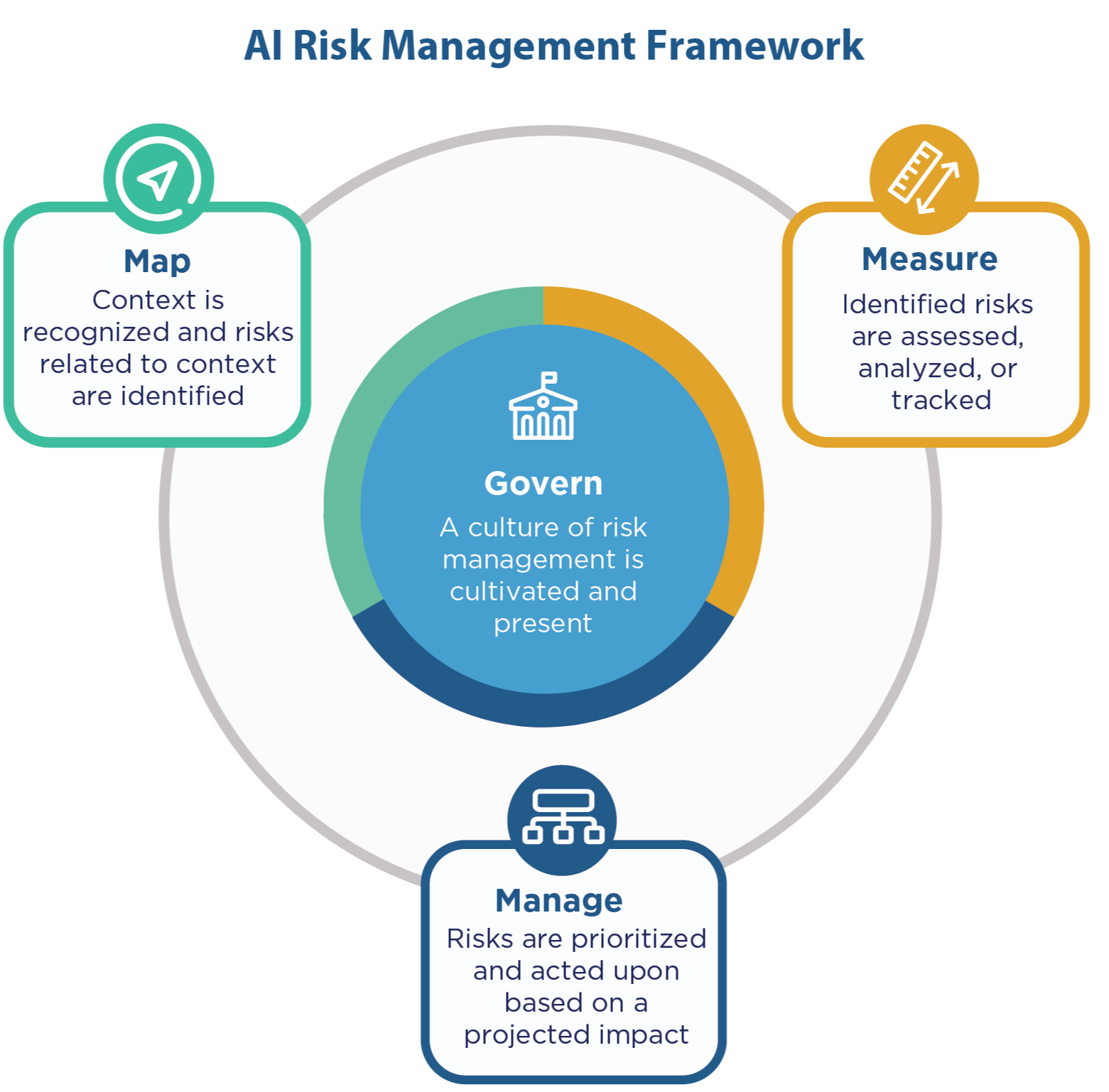
Functions organize AI risk management activities at their highest level to govern, map, measure, and manage AI risks. Governance is designed to be a cross-cutting function to inform and be infused throughout the other three functions.
This is why strategic alignment belongs within governance. Governance is not something applied after an AI system has been chosen. It is also the discipline of deciding whether the system should exist.
Before asking where your organisation can use AI, define the problem clearly enough that AI may not be the answer.