
When does AI quality assurance become surveillance?
Monitoring can support safer, better work. But when observation becomes continuous, individualised and consequential, quality assurance requires much stronger justification.
In today’s governance note, I want to separate two activities that are easily placed under the same heading: checking whether work meets an appropriate standard, and continuously turning a worker’s conduct into data.
On 28 September 2026, the Guardian reported that Multiverse was using AI to analyse transcripts of online teaching sessions, assign instructors risk classifications and identify possible problems for managers. Instructors described feeling constantly scrutinised and said the system sometimes treated responses to learners as departures from the expected teaching pattern. Multiverse said the purpose was to improve learner experience, that performance reviews remained with human managers and that the system’s most consequential action was recommending a personal review of a session. Read the Guardian report. The Guardian
The case is useful because a legitimate objective does not automatically justify every means of pursuing it. Things such as Teaching quality, service standards, regulatory compliance and customer safety are of importance. Organisations may reasonably observe work, sample interactions, and investigate evidence of a problem.
AI changes the governance question because it makes comprehensive observation and individual scoring comparatively easy. A pause, hedge, digression or change in tone can become a performance signal. Yet the same behaviour may reflect a worker adapting to a learner, responding to an accessibility need, communicating in an additional language or exercising professional judgment. The organisation must therefore govern the distance between the outcome it cares about and the behaviour its system can conveniently measure.
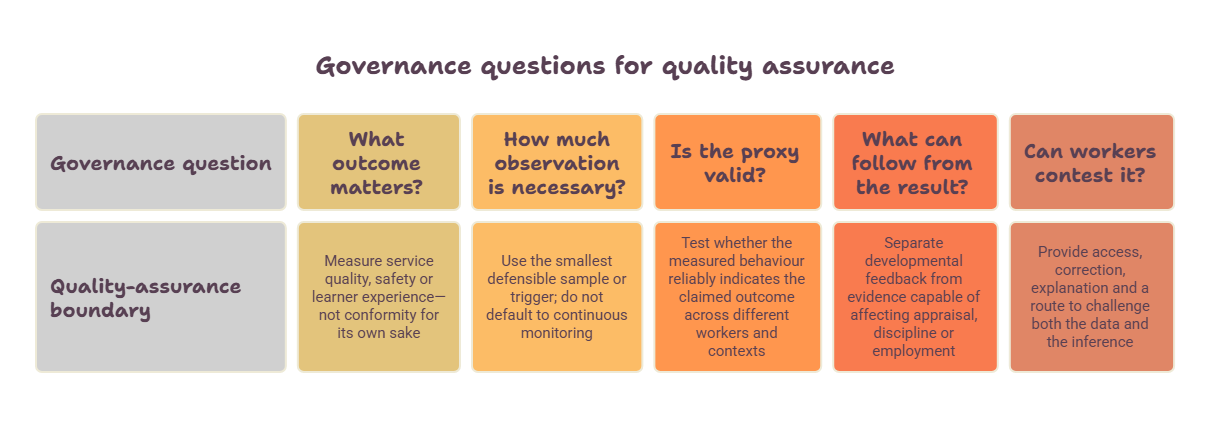
I would define the boundary before monitoring begins:
The UK government’s workplace-monitoring consultation, published on 8 July and closed on 30 September 2026, explicitly examined clarity, transparency, worker voice and industrial relations. Read the consultation. GOV.UK
In its response, the TUC argued that consultation and negotiation are prerequisites for fair and effective technology adoption. Acas added an important qualification: consent to workplace surveillance may not be genuinely free because of the power imbalance between employer and worker. It also identified risks including intensified work, reduced autonomy and algorithmically amplified bias. Read the TUC response and the Acas response. TUC
The ICO’s guidance provides a practical baseline: define the purpose, choose the least intrusive means, assess the impact, involve workers or their representatives, and do not assume that purchased monitoring software is compliant. The employer remains responsible for how and why monitoring occurs. Read the ICO’s worker-monitoring guidance. ICO
Before deployment, organisations should document what evidence links the chosen proxy to the real outcome, which groups may be measured differently, what data will be retained and which decisions the result may influence. Workers should be involved while those choices are still open to change. Quality assurance becomes surveillance when greater visibility is treated as evidence of greater control.